


A discussion with Dave Coverly and Hilary Price about the process of making cartoons, the anatomy of making a funny cartoon and how they discovered the power of cartoons
This conversation is excerpted from The Funny Times Podcast, which explores the history of humor — and the relationships and stories Funny Times has cultivated over the past 40 years in print. Dave Coverly and Hilary Price, long-time cartoonists whose works frequently appear in our publication, are also the creators of Speed Bump and Rhymes with Orange respectively. Here are some excerpts from their discussion with Funny Times editor Mia Beach:
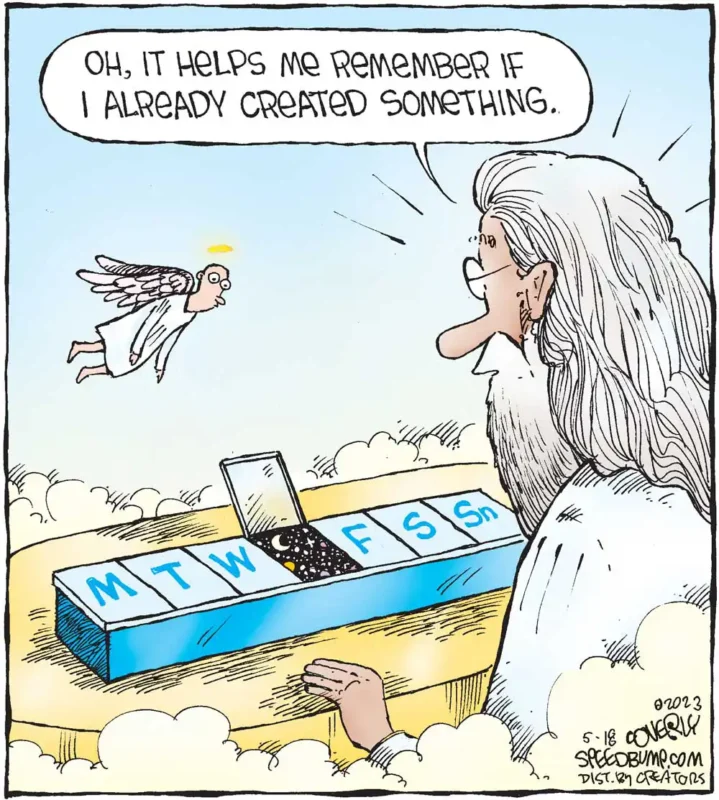
Making a Cartoon: Then vs Now
Mia: What are some of the ways that you’ve seen cartooning change over the years?
Dave: I don’t see a big change in artwork. People draw the way they draw.
A bigger conversation about that as far as “how the internet changes art” is that you see so much more of it. It used to be a running joke that you’d be chasing the FedEx truck because you had deadlines that weren’t tied to emailing them.
I was FedExing my seven cartoons every week. That’s so stupidly expensive. And you knew that the FedEx truck came at 7 p.m. And so at 6:45, I’m throwing my cartoons down the stairs and Chris is running out the door in the car chasing, making sure she gets there in time. That was a real thing.
Hilary: The first time I sent a FedEx to my editor, I didn’t know what I was doing and I sent it to myself.
But I’ve gone to digital drawing, you are still doing pen and ink. For me, it was about shaving off little bits of time. I had a scanner that got more and more wonky. Turn it off, turn it on, give it a present, say “Hello, is it blinking?” And because it was an oversized scanner, as I was drawing four by 13 instead of just a regular eight and a half by 11, it was going to be either buy another oversized $1,200 scanner or buy a Wacom tablet. That was what made me decide to do a Wacom tablet.
I was still doing the same process. I have my line guide, that’s a layer, then I have my blue pencil layer and then I ink over it and then it’s more streamlined.
But with the deadline, any minute that you can save yourself for me was important. It gives me a freedom that I’m not like, “Oh, it’s got to be perfect.” So it gave me a freedom to try stuff that I wouldn’t if I were on a nicer piece of paper.
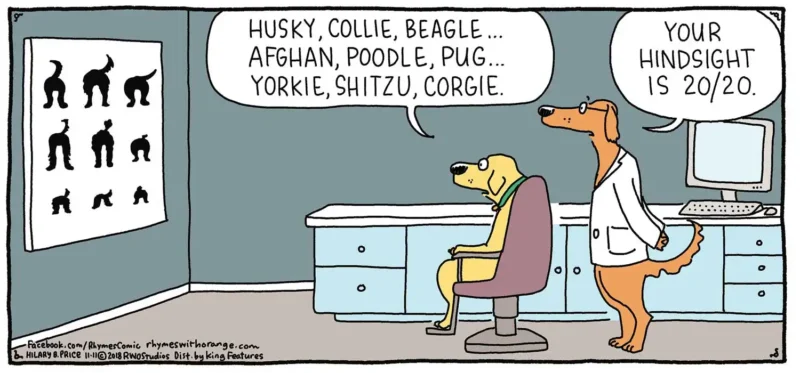
What Makes a Cartoon Funny
Hilary: I think my greatest pleasure moment is getting the idea. But I would say over my lifetime, the pleasure moments have changed a little bit. I think in the very beginning, the pleasure moment was getting the idea.
And then I would say that pleasure moments were when someone said to me that was so true. Not that it was so funny, but that was so true. That’s a big pleasure moment.
And then I would say that pleasure moments were when someone said to me “that was so true.” Not that it was so funny, but that was so true. That’s a big pleasure moment.
And then now it’s also just back again to getting that idea. And I think that that reflects the pleasure moment that readers get, where it’s the discovery of people getting the joke, not the actual joke. It’s that squirt of understanding.
Dave: That’s a big good title for your next book, the squirt of understanding. Dibs on that one.
Humor comes from surprise too. That’s sort of the generative, “Oh, I didn’t see that coming”. So it kind of takes you, if you see it coming, it’s not as funny. And back to what Hillary said too, about not just people see it as funny, but they see a truth in it.
“There’s a nugget of truth in every jest”. The best humor comes from something you recognize because A, it’s a surprise, but B, it doesn’t have to be explained.
And there’s that Mark Twain quote, which is, “There’s a nugget of truth in every jest”. The best humor comes from something you recognize because A, it’s a surprise, but B, it doesn’t have to be explained.
How Cartoonists Get Inspired
Dave: When my dog passed away, it’s like, man, the last thing you feel like doing is being funny.
And so there’s sort of a two tiered aspect of it is as a professional, you got to be able to sit down and be like, “Yeah, that sucked. And I’m taking a day off.” But now you have that muscle memory. So you kind of know how to do it and how to get back in there.
Also, there are times I found where sh*t’s going down, it’s not a great week and it’s almost like I go to my happy place. So when I’m thinking of ideas, it’s almost a relief, like, “Okay, I have to do this.” And maybe for a couple hours, at some level, I’m not thinking about that terrible thing that happened.
Then all of a sudden, you’re like, “Oh, that terrible thing happened but at least I have my ideas.” It’s part of being a pro, right?
Hilary: Yeah, I’d say so. And also, I’d say that some of the hard stuff informs some humor.
Dave: Oh, sure. That’s a good point.
Hilary: Like breakup cartoons, that’s good stuff.
Dave: Yeah. I think you need a beat away from it. Because people think you’re just coming up with like- the muse is there, and you’re grocery shopping, then you got a cartoon idea about Cheerios.
But actually what you’re doing is you’re absorbing all this stuff. And then a day, a year later, you’re sitting on your ass, and it’s percolating. And then that little breakup thing comes to the back of your mind, and it’s no longer painful. You’re like, “Yeah, but what if it didn’t happen over text? What if it happened by like, carrier pigeon?” And then you have some space from it. That’s kind of what you need, especially for the hard stuff.
Hilary: I see it like a compost pile, right? Like throwing all the garbage on top, and then it slowly turns down into like- and then things touch each other, the nasty piece of cabbage touches the takeout container and suddenly, boom.
Dave: Suddenly, you’ve got a feast.
Hilary: A feast! A feast for a worm!
Dave: Yeah. That’s the sequel to the Squirt of Understanding. I’m gonna make a cologne. Squirt of understanding.
Cartoonist Origin Stories
Dave: I was in seventh grade. We had a thing called artists of the month and you draw something and then the head of the library, Mr. Moody, would select the best drawing and then it’d be hanging in the library for the month. So the first month I won, I drew an elephant. And the second month, I collected beer cans and I drew this beer can with George Washington, but then I made a caption that said something like, “I cannot tell a lie, this beer stinks.”
And so I’m all excited, hoping I win again and then I go in and something else has won. And then I went to pick up my art and I’m like, “where can I get my art back?”
And he’s like, “no, I threw it away.”
And I said, “what?”
And he said, “that was offensive, what you do is offensive and non-patriotic. And I thought it was just garbage. And so I threw it away.”
And I was like,“but that was my drawing.”
That was one of those teaching moments in my life where I’m like “oh, drawings have an impact. Like, I pissed him off.”
Hilary: I had a moment where I was little. I was snooping through my parents room and underneath their bed, there was my mom’s plastic thing of scarves. I pulled that out and underneath the scarves, there was this folded up piece of paper.
I unfold the piece of paper and there’s a cartoon and it’s to my mom and it says, “Love David.” I was like, “Dad’s name is Michael, what is this?”
I asked her and she’s like “that was something that her high school suitor had made. It was a great cartoon.” I was like, “Oh, cartoons have power,” in that same way.
And so I asked my mom, “what did you do with that cartoon? It’s no longer in the scarf storage.” She’s like, “Oh, it’s with the wills.” And I was like, “does dad know?” And she’s like, “No.”
Dave: It’s interesting on multiple levels.
Hilary: Oh, yeah.
Dave: People keep things though.
Hilary: You know what? Yes, absolutely. He doesn’t care. But for me, for a young person, cartoons have capital.
Dave: Yeah. And adults have complicated lives.
Hilary: Yeah. That’s true.
Dave: Yeah. That’s funny. That’s a good story. I’m gonna start digging underneath my parents’ beds. Or maybe not.
Mia Beach: I don’t recommend it
This interview has been edited for length and clarity.
This conversation is an excerpt from The Funny Times Podcast, a series celebrating the 40th anniversary of Funny Times. Listen to the full episode:
If you’re interested, click here to see more of Dave Coverly’s work and click here to see more of Hilary Price’s work.
You can also click here to see some of Dave’s Funny Times Cartoons and you can click here to see some of Hilary’s Funny Times Cartoons.


George Washington: Cherry (tree) president- cannot tell a lie.
Richard Nixon: Tricky Dick- cannot tell the truth.
Donald Trump: Orange Felon- cannot tell the difference.
Yep, published cartoon. From “offensive” “unpatriotic” to “funny.” And the teacher would have thrown it in the garbage.