Ruben Bolling and Tom Tomorrow talk about how they hustled their way into cartooning alongside Matt Groening and Linda Barry, the struggles of delivering political satire in today’s world and their personal experiences with the transition from print to the web.
This discussion is excerpted from The Funny Times Podcast, which explores the history of humor — and the relationships and stories our paper has cultivated over the past 40 years in print.
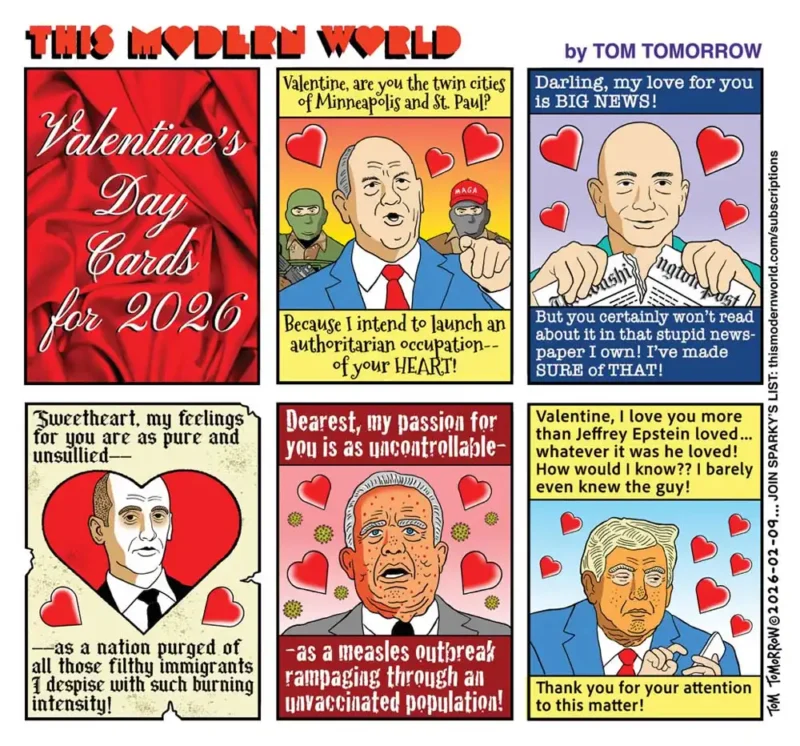
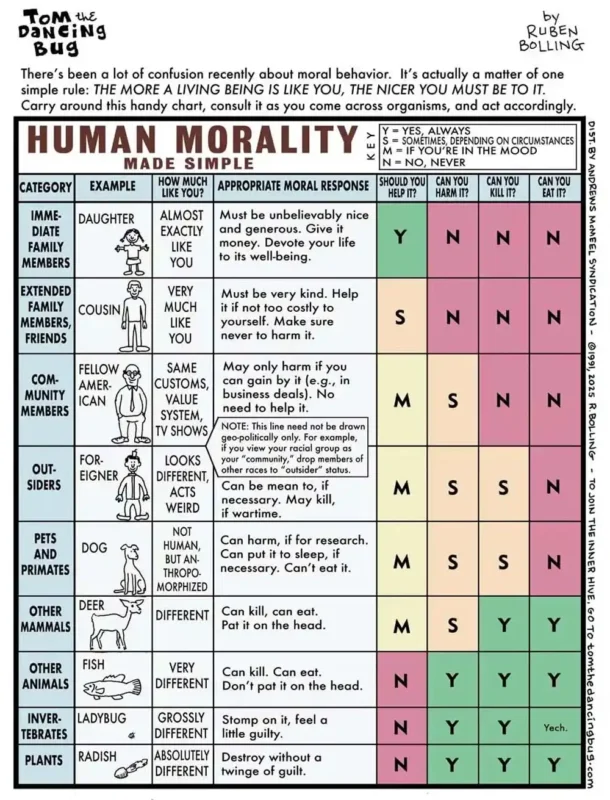
Ruben Bolling and Tom Tomorrow, long-time Funny Times contributors, are also the creators of Tom the Dancing Bug and This Modern World respectively. Here are some excerpts from their discussion with Funny Times editor, Mia Beach.
On Coming Up as Gen-X Cartoonists
Ruben: So suddenly, there was this growing industry at the exact same time that I was doing a weekly comic strip. It was one of the only times in my life where I was in the right place at the right time. And that made my career.
Tom: I would add to that thought. We’re similar ages and, obviously, as we’ve discussed, I came into this at the same moment. At that time, I felt like we were too late because it seemed that this preceding generation – Matt Groening, Linda Barry, Charles Burns, and various other people – it seemed like they already had a lock on it. It felt like the old weeklies were largely being published by people a few years older than us; they were very specifically a boomer phenomena and we were sort of the upstart kids. I don’t know if we’re Gen X or in the intermediate zone but we’re not boomers. There was a very distinct divide, very much a sense that we were just the kids coming in trying to get our own space. And it felt like the space was all locked out already. It clearly wasn’t, and I started doing well, and in retrospect, I recognize “Oh, no, I was there.” I was in a very enviable position. I was there at a really good moment.
Ruben: In fact, I feel as though Matt Groening did us a huge favor. I feel as though he created the market for this. He was the one who convinced these newspapers that in order to be an alternative news weekly, which everyone wanted to be like in that world, you had to have these cool alternative comic strips. He invented the market that we rode in on. And, it’s true that they had their spots in the legacy alternative Newsweekly, newspapers, the LA Weekly, and Village Voice. But a lot of them weren’t syndicated, or all over the place. But they were there.
Those papers were looking to expand or change things. And then there were all these other papers that were like us, the young upstarts, and they wanted something different. In LA, the LA Weekly, the big paper, had Matt Groening, and maybe the next one wanted Tom Tomorrow or Ruben Bolling. It made our careers. That’s how we got our readership. Even though the alternative weeklies are gone, we’re still riding that wave because we built a strong readership early on, so now our subscribers, our members, and our subscription memberships, is what’s driving our ability to continue to cartoon today.
On Being a Political Cartoonist in the Trump Era
Ruben: A common cocktail party thing to say is, “Oh, you must love the idea of so much material. Trump provides you with so much material or there’s so much going on.” And I don’t feel as though it’s helpful. What I find the most difficult is because things are so dark and so serious, it’s hard to satirize. And Trump is better at it than we are. I won’t speak for you, Dan, but he is a genius at satire.
What I find the most difficult is that because things are so dark and so serious, it’s hard to satirize. And Trump is better at it than we are.
Tom: I can’t tell you the number of times I’ve had to scrap a cartoon because he actually does the thing that I was writing as the ridiculous example. Satire is the art of taking things to the absurd extreme. And we are living in the absurd extreme. I’ve been writing a lot more dialogue strips of the various characters in the Oval Office.
I try to have these somewhat exaggerated, absurd dialogues that get out the underlying truth of the situation. As I say, it’s almost a matter of bearing witness because there’s no way to outdo the awful reality of where we are. I would ask how do we keep doing satire? If you suddenly find yourself in the middle of the ocean, you just try to keep your head above water. That’s how we keep doing satire.
Ruben: It is that tough. And bearing witness is a great way to phrase it. What I used to do is take what a politician would say and exaggerate it. But when he’s saying things like “we’re going to take over Greenland,” you can’t exaggerate that. What’s next? So what I find myself doing is taking his words and putting them in a different context. Using his words, I’ll make him another character and I’ll find a premise about what’s going on. It’s really hard and especially the tone. I don’t want to make gags about Trump like, “Oh, his skin is so orange.” I think that it almost normalizes it. It takes it, and minimizes what’s going on. So everything has to have this sort of urgent tone, but obviously, it has to be funny and entertaining.
Tom: If you’re going to try to capture his cadence, his speech rhythms, then you will only have a wall of text because he throws in so many verbal ticks in everything he says. You have to sort of compress his dialogue. In a way, you end up making him more rational, no matter what idiotic stuff you have him saying. You have to write it in a way that the reader can actually read it and not just throw your cartoon away.
If you think we’ve got a wall of text now, the guy who plays Trump on Saturday Night Live, he could do that. He’s got the space and the airtime to just go off on these bizarre tangents. But if we try transcribing one of those little sketch comedy bits, there isn’t the space to do that.explained.
On The Change from Print to the Web
Tom: So in this transition from print to internet, print used to be a kind of wide distribution vehicle, like you were saying, it’s just out there, it reaches whoever picks up the paper. Now we are a destination that you choose to go to. I think there’s less of that sort of serendipity of print on the internet. So you have a wider audience, but not quite as deep an audience- When Ruben and I were in The Village Voice 25 years ago, we could walk into any room, any party in New York City, and there was an 80-90% chance of people who knew who we were, and had read our cartoons. It’s not that way anymore. I hang around with journalists in their 40s sometimes, and half of them have never heard of us.
Ruben: I don’t know if I agree with that. At least for me, I feel as though that is true that within New York where my comic appeared in the alternative weekly, I would have recognition, but I feel as though on the internet, the number of eyeballs may be even more because of the entire country and world. I feel as though there’s more people reading my comic now than ever. But they’re all dispersed, and they’re silent and it’s people who are seeking it out. I feel as though, in many ways, the comic is sort of seen more now than ever.
Tom: And honestly, we are less dependent on the whims of editors. In those days, if an editor didn’t want to run you or drop you then you were just locked out of that market, you reach no one there. We don’t have that problem anymore.
Mia: But your audience has a lot more opportunities to see things. It’s not being whittled down to a choice.
Tom: Oh, we’re in competition with everything. We’re in competition with podcasts and clips of the last Saturday Night Live and late night monologues. Those are teams of writers coming up with that stuff. And we’re just like these guys out here on our own going, “Oh, got to think of a funny idea.”
Ruben: When we started, there was so little satire of any kind that people could see there. There would be like the Tonight Show monologue, there’d be Saturday Night Live. The Daily Show changed everything because then the satire cycle got so much faster. I used to be able to do a comic a week. Now it changes daily or hourly. The amount of satire changed that in terms of daily show-
And Trump changed everything because once you do something about Trump and you’re like, “wow, this is a huge story. Everyone’s talking about this, this is going to be going on for forever.” And then so, you submitted for the next week for it to run in two days and two days later, no one’s talking about it. It’s old news because everyone’s talking about the last thing he did.
Tom: His response to Rob Reiner was a week ago.
Ruben: If I decided to satirize that now, people would be like, “Why is he still talking about that?” Whereas that was totally not the idea years ago.
This interview has been edited for length and clarity.
This conversation is an excerpt from The Funny Times Podcast, a series celebrating the 40th anniversary of Funny Times. Listen to the full episode:
If you’re interested, click here to see more of Ruben Bolling work and click here to see more of Tom Tomorrow’s work.
You can also click here to see some of Ruben’s Funny Times Cartoons.